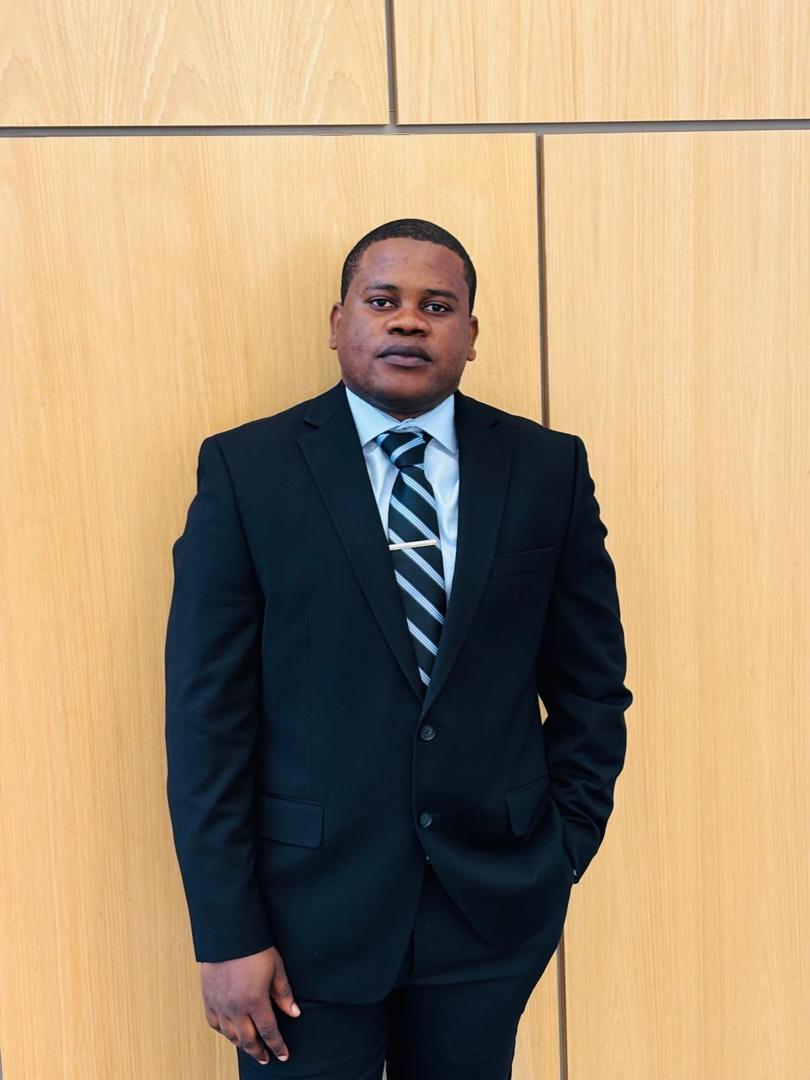
Monsuru O. Dauda, PhD
No Magic In Success
PH.D. DISSERTATION SUMMARY
The electrochemical reduction of CO₂ offers a promising route to sustainable chemical production, converting atmospheric carbon into valuable feedstocks using renewable electricity rather than fossil fuel-based processes. Despite substantial progress in CO₂ electroreduction, several gaps have continued to limit both mechanistic understanding and practical translation of this chemistry: quantitative selectivity relationships remained poorly defined, systematic studies varying dopant identity and concentration under identical conditions were lacking, the identity of the common intermediate from which C₂₊ products diverge was debated, electrolyte engineering lacked systematic exploration of the pH-cation-anion parameter space, and product crossover stood as the field's central unsolved challenge, with conventional membrane electrode assemblies fundamentally unsuited to recovering dilute liquid products at high current density.1 This dissertation addresses these gaps by assessing how each component of the electrochemical system controls CO2 electroreduction to sustainable chemical production by moving systematically from electrocatalyst to mechanism to device to application, elucidating the mechanisms governing selective CO₂ electroreduction to C₁ and C₂ products and advancing the technology toward industrial viability through electrocatalyst design, mechanistic understanding, electrolyte optimization, and reactor engineering, closing with an integrated techno-economic analysis paired with life cycle assessment to evaluate commercial and environmental readiness.1-34
Among all metallic elements, copper stands out as uniquely capable of catalyzing the carbon-carbon coupling required to build C₂ products such as ethylene, ethanol, and acetate, yet pure copper suffers from poor selectivity among these competing pathways. Alloying copper with phosphorus, tin, and selenium to form Cu-P, Cu-Sn, and Cu₂Se electrocatalysts steers selectivity toward a specific target product, achieving ethylene at 73% Faradaic efficiency, ethanol at 60%, and acetate at 50%, with electrocatalysts remaining stable over 250 hours of continuous operation.2-8 In situ X-ray absorption, XPS, XANES/EXAFS, XRD, SEM-EDS, and Auger spectroscopy confirmed that Cu⁺ persists kinetically despite thermodynamic instability, and that increasing partial positive charge on copper (Cuᵟ⁺), ranging from +0.13 to +0.47, systematically shifts selectivity through a shared acetyl intermediate, low charge favoring ethylene, moderate charge favoring ethanol, and high charge favoring acetate, with DFT calculations correlating Cuᵟ⁺ with both selectivity and activesite density.2,3 In a zero-gap membrane electrode assembly, tin content itself acts as a selectivity dial: low tin content promotes carbon-carbon coupling and yields 60% ethanol, while high tin content favors formate at 80% efficiency, with density functional theory pointing to an optimal surface composition between 25 and 38% tin.3-19 Operando Raman and surface-enhanced Raman spectroscopy independently confirmed that dilute Sn doping enhances C–C coupling on CuSnx surfaces, corroborating the electrochemical and spectroscopic picture.19
Electrolyte conditions are a powerful lever, but with a tradeoff. Alkaline conditions favor carbon-carbon coupling but lose carbon efficiency to carbonate formation. Acidic conditions improve utilization but suffer from hydrogen evolution and poor stability. So we searched for a sweet spot minimizing carbonate formation while maximizing FE to ethylene. We found it at weakly acidic pH 6: 73% ethylene efficiency at 300 mA cm⁻², sustaining 51% single-pass CO2 conversion over 400 hours.⁷ Selectivity is governed by CO surface coverage rather than pH directly, confirmed by CO/CO2 co-feed and buffering experiments.¹²⁻¹⁴ Larger cations like cesium suppress hydrogen evolution from 31% to 4%, and a Marcus model shows the dominant proton donor shifts from water at pH 14 to phosphate at pH 6, minimizing this competition.7,8
Every liquid product made so far was quietly undermined by product crossover: in conventional membrane electrode assemblies, 82 to 96% of the ethanol produced at the cathode migrates across the membrane to the anode through diffusion and electroosmotic drag, where it dilutes below 0.05 wt% and oxidatively degrades, rendering it unrecoverable.⁹,¹¹ A flowing-electrolyte, dual-membrane electrolyzer with cathodic, anodic, and intermediate chambers cuts this crossover from 94% down to below 2%, a roughly 98% reduction. The result is 63% ethanol Faradaic efficiency at 9 wt% concentration, and when operated with water alone instead of an alkaline electrolyte, the same architecture also enables direct formation of formic acid and acetic acid.¹¹ Anion exchange membrane transport studies and accelerated lifetime testing confirmed the durability of this architecture,¹⁷⁻²⁴ while parallel work quantified water and potassium transport, membrane durability, and individual MEA component durability over extended operation.¹⁷⁻²⁶
Acetic acid should have been an easy win. Among all the possible products of CO₂ reduction, it was one of the most commercially desirable, prized not just by the chemical industry but by an emerging application close to home: eagriculture, where CO₂-derived acetate could feed engineered microbes and crops directly, bypassing photosynthesis altogether.27 On paper, it looked like exactly the kind of product this dissertation had been built to deliver. But to run a balanced electrolytic system, most approaches leaned on cations like potassium or sodium to stabilize the reaction, and those cations came with a price tag. At the same Faradaic efficiency, adding them pushed production costs up by $0.50/kg,27 and converting the resulting acetate into industry-ready acetic acid still consumes more acid downstream. Operating below acetic acid's pKa of 4.76 sidesteps both costs by producing the acid form directly, but conventional inorganic buffers at that low pH invite the hydrogen evolution reaction to compete for electrons. A modified organic acid buffer breaks this trade-off, holding acetic acid efficiency at 48% without the added expense, while the same dual-membrane, flowing-electrolyte architecture recovers 99.9% of the product with no measurable crossover.11,27
Methanol, the simplest alcohol, has proven paradoxically difficult to make electrochemically. The conventional route through carbon monoxide is fundamentally bottlenecked because CO₂ binds far more strongly than CO to the cobalt phthalocyanine electrocatalyst typically used, trapping methanol selectivity below 20% regardless of current density, pH, or doping. Rerouting the reaction through a formic acid intermediate sidesteps this limitation entirely, lifting methanol efficiency to 54%; across a series of copper alloys, we identified a volcano-shaped relationship between selectivity and formate binding strength.28
An integrated Aspen-based techno-economic analysis, paired with life cycle assessment, shows that C₁ products (carbon monoxide, formic acid, and methanol) all approach cost parity with fossil counterparts: CO at $0.32/kg against a $0.15/kg fossil benchmark, formic acid at $0.40/kg, below its $0.55/kg fossil benchmark, and methanol at $0.68/kg against $0.28/kg fossil and $0.90/kg bio-based. C₂ products cost roughly twice as much, except acetic acid, which reached near cost parity: ethylene at $2.05/kg against $0.97/kg fossil and $1.90/kg bio-based, ethanol at $1.36/kg against a $0.65/kg bio-based benchmark, and acetic acid at $0.90/kg against $0.57/kg fossil and $0.80/kg bio-based. All products achieved near-negative carbon intensity and Pareto dominance over their incumbents.29
A composite molecular Cu-based electrocatalyst extends this platform toward next-generation membrane electrode assemblies,21 and, as proof of concept, electrolyzer-derived acetate was shown to support living Spirulina cultures and to be converted into cellulose acetate, while electrolytic methanol and ethanol served as feedstocks for carbonate ester chemistry, building on preliminary carbonate-synthesis work reported through the 2025 ECS F. M. Becket Research Fellowship.9
Taken together, this dissertation establishes the mechanistic and engineering foundation for selective CO₂ electroreduction: tailored copper charge states control product selectivity, weakly acidic electrolytes balance CO₂ activation against unwanted hydrogen evolution, larger cations favor carbon-carbon coupling, and dual-membrane architectures finally make concentrated liquid product recovery possible building on and substantially extending the electrocatalyst framework first developed in the author's M.S. thesis.10 This work demonstrates that carbon once regarded as waste can be reclaimed as a viable feedstock for the chemicals society depends on.
This dissertation grew from a desire to pursue research that advances sustainability, ultimately centering on the electrochemical conversion of CO₂. I thank my advisor, Prof. John Flake, for the mentorship, patience, and guidance that shaped my growth as a scientist, and my committee: Professors Craig Plaisance, Anthony Engler, Phillip Sprunger, and Shawn W. Walker, for their insight and support. I'm grateful to my lab colleagues, past and present, especially Dr. Mustapha Bello, Dr. John Hendershot, Dr. Junghyun Park, and Ignace Agbadan, along with the many other graduate students, postdocs, and undergraduates I mentored, whose collaboration and curiosity enriched this work. Thanks also to our collaborators: Prof. Plaisance's group for DFT calculations, Nicholas Lombardo for electrolyzer design, Professors Orhan Kizilkaya and Phillip Sprunger for data validation, Prof. Engler for manuscript feedback, and collaborators supporting the Spirulina cultivation and cellulose acetate work, along with LSU Advanced Microscopy and Analytical Core, Argonne National Laboratory's Advanced Photon Source, and the University of Delaware. I thank the team at Encore CO2, where I served as Chief Technology Officer, for the chance to translate this research toward real-world impact, and the National Science Foundation for funding. I'm grateful to the community of African graduate students at LSU, where I served as president, for a sense of home throughout this journey. Finally, to my wife, Tawakalitu Dauda, our daughters Mahida and Mahira, and my friends and family: this work is dedicated to you and would not have been possible without your unwavering faith in me.
Patents:
Publications
Awards
Positions Held
Event Organized
Experience
© 2025 daudamonsuru.com, All Right Reserved.
Designed with